Sunday, September 27, 2026

The Academic and Social Values of Ethnic Studies- Christine E. Slater

Meyers: Ethnic studies curriculum opens a door for all of us to be seen -  San José Spotlight

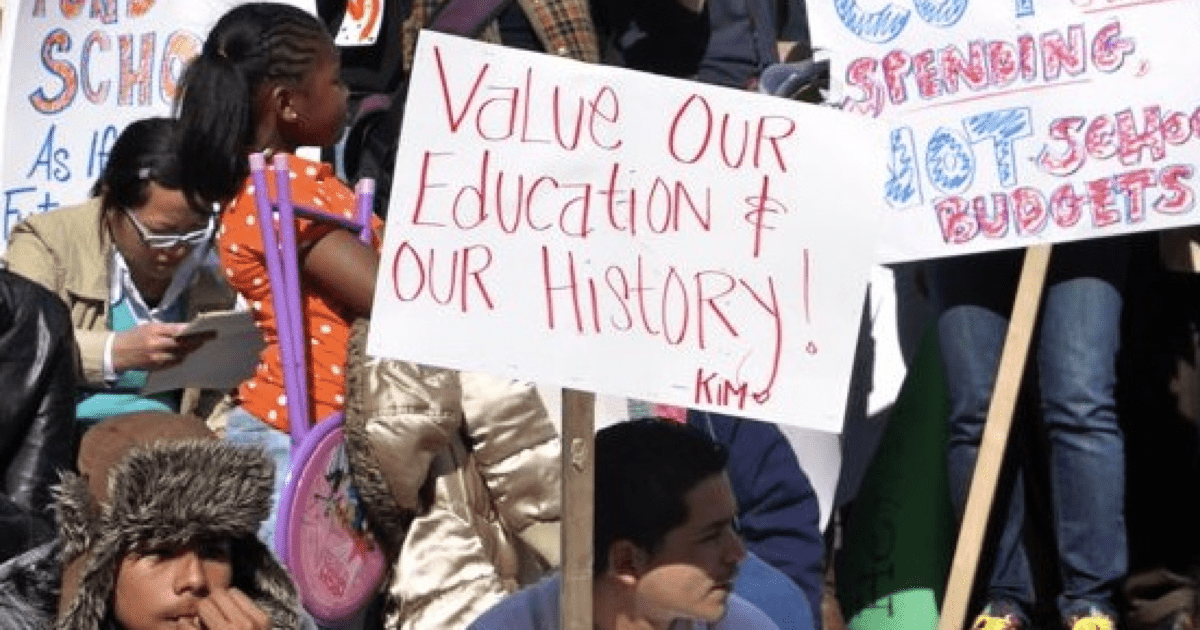
Quote 1: "Whites continue to receive the most attention and appear in the widest variety of roles, dominating story lines and lists of accomplishments" (Slater, page 2). This stood out to me because this proves that in school we are taught mostly about White Americans. Other racial groups tend to be more discredited than white groups. When the attention is brought up upon them, it is usually about negative things and makes it seem like they aren’t as important in shaping history, even though they were. For example, the text brings up how it is when speaking about African-Americans. It mostly talks about slavery, and we only bring up Native Americans when we’re talking about the past. This leaves out a lot of details for students to learn while they’re in school. 

Quote 2: "At first Carlos had no interest in more school, but his friend was so enthusiastic that Carlos finally decided to go see what Chicano studies was all about. #at hooked him on education" (Slater, page 1). This shows that students are more interested in learning when they can relate to it. The text said that this was his first time his curriculum was centered around his reality. he was able to connect this content to his own identity, which made him want to know more. This also showcases that this isn’t in our curriculum at all because he didn’t get this experience until college. Ethnic studies made school feel more meaningful because the information is more personal to him. 

Quote 3: "While White teachers were willing to include knowledge about diverse groups, they did so intermittently and within a Eurocentric narrative" (Slater, page 4). This is important because it shows that even though they include some knowledge, there’s a lot that’s left out. It is not continuous information, and big chunks are not included. History cannot be properly taught when there is information missing. Even when they are being taught, it is taught through a Eurocentric way. This leaves out the actual experience the diverse groups were having, which affects how diverse children can relate to this content. This shows it was simply thrown in here and there and not actually being taught. 

Reflection- A question this made me raise is "why do you think it's important that ethnic studies are added into school curricula?" This text brings up why it is important for ethnic studies to be included in students' education. Without learning about this, students are missing a huge piece of history and are receiving altered information. It helps students learn how our history was shaped and why our history is the way it is today. Students are able to connect to this content and feel represented when it is not only centered on White Americans. When they are able to connect to things that they are learning, it keeps them engaged because they want to learn more. Only learning one version of history won't benefit anyone. 

AI statement: I used AI to ask, "Why is it important to involve ethnic studies in school?" to help add more to my explanations.

https://ethnicstudies.org/2021/09/26/why-ethnic-studies-matters/

Saturday, September 19, 2026

Shifting the Paradigm from Deficit Oriented Schools to Asset Based Models- Shannon Renkly and Katherine Bertolini

How to Teach Kids Teamwork: 5 Effective Strategies

Argument- The author’s argument is that we should focus more on what students can do rather than what they cannot do. Students' assets need to be built up so that they can learn and grow at the appropriate pace. One way assets can be effectively built up is through supportive adults in the students' lives, such as their teachers. When focusing on what the students cannot do in the deficit model, they are working reactively rather than proactively. When working proactively, they can act ahead of time to prevent falling behind and understand something they’re struggling with before it’s too late. Building up their assets helps somebody become more successful in their future. When working from a deficit model, the students are blamed for the failure of the system. When using the asset model to focus on their strengths, skills, talents, interests, and competencies, it builds up their confidence. When the asset model is used, there's a higher emphasis on building up their student strengths, which is important to help the students thrive. There are external assets which rely on the relationship formed by adults in their lives and internal assets which are developed to guide themselves. The more assets a student has, the more they thrive in school. The asset model also helps bring the community and staff together. When a student knows they can do something, they will want to push themselves to do harder things and set goals on their own. 

Reflection- This shows that the adults' and students' lives have a very high impact on their lives. The more contact time students have with positive adults. It helps build up their assets, which is very important for them to have. When students know they have adults who support them, it makes them try harder in school and push themselves. They also don’t constantly feel put down since there’s not a lot of focus on what they can’t do. As a future educator, I want my classroom to always be a welcoming, safe space where my students can learn, grow, and succeed. I never want to define my student by what they struggle with, I want to help them work through it. It is a very frustrating feeling to feel you are falling behind, so it is important to focus on things they know they are capable of. I want to always build up my students' confidence, and I want them to try more challenging things because they feel they can not because I am telling them to. 


AI statement- I used AI to ask "why is it important to focus on what children can do rather than what they can't" to make sure I had all the important points. 

https://www.memphis.edu/ess/module4/page3.php

Sunday, September 13, 2026

What "Counts" as Educational Policy? Notes Toward a New Paradigm- Jean Anyon

Free Classes for Poor Children's | GoGetFunding

Quotes- For this week, while reading "What 'Counts' as Educational Policy? Notes Toward a New Paradigm" by Jean Anyon, I found a lot of quotes that stood out to me. This text mentions how urban schools are supposed to have high-quality education, but they haven’t been able to provide this for students. Some reasons why they aren’t able to are neighborhood poverty, unemployment, and joblessness, which are not addressed in the education policy. There are very low levels of city district funding, which leave schools with outdated buildings, broken computer labs, and overcrowded classrooms. Children who grow up in poverty have consistently negative effects on their cognitive development, health, and behavior. It’s not necessarily the family‘s fault because there are no minimum wage raises, men and women aren’t paid the same, and there is still racial discrimination. Anyon wants “ a new education policy paradigm,” with this, she wants to create a higher living wage, create more jobs in cities that offer career ladders, and help low income residence fill them, tax wealthy families and corporations, enforce federal anti-discrimination, reduce segregated housing, and add more public transit routes. She gives a lot of evidence that families would be helped financially and students would improve educationally. Families who moved to places with increased opportunities and better neighborhoods improved their children’s behavior and educational outcomes.

Quote 1-"This economic and social distress can prevent children from developing their full potential and can certainly dampen the enthusiasm, effort, and expectations with which urban children and their families approach K–12 education" (Anyon, page 74). This is important because it shows how the economic conditions affect the students' development. The macroeconomic policies set wages below poverty levels and do not train people for fit jobs or even ones that exist, leaving the wealthy to have all of their money, and allowing economic discrimination against people of color. This makes it so that poor people will always be poor and there’s no way for them to dig themselves out. These economic conditions are so far beyond that they are hard to overcome. These conditions hold children back, and they won't be able to progress if they don't improve.

Quote 2- "This suggests that policies to counter the devastating effects of macroeconomics and regional mandates and practices should “count” as policies we call to create equity and equality in urban districts and schools"(Anyon, Page 83). This is important because it is talking about the policy and how we need to reverse the effects of the damages to benefit the students. This new education policy promotes equality and better opportunities for students. Macroeconomic policy should not trump the effects of education policies. Our economy has very unequal opportunities and discrimination that allow this to keep happening.

Quote 3- "It is important to understand that these findings do not suggest that poor students are of low intelligence; rather, the studies point to the power of the economy — and of economic hardship — to place extremely high hurdles to full development in front of children who are poor" (Anyon, Page 76). This is important because she emphasizes the blame on the policy, not on the students. It’s not the students who are the problem, and it’s not the way their brains work; it’s the way they are growing up in poverty that is harming their education. They go to low-funded schools, and they are not learning how wealthy children are able to.

Reflection- I want to reflect upon this new education policy, and I'm wondering what others think about it. I personally think it's a really good idea, but it will be hard to enforce since it goes beyond the school. That is what needs to be done, though, because the economic factors are also what are diminishing their education. Some of the financial help would be very modest and still make a big difference. I think that gap between the wealthy and the poor is a major factor, and there needs to be some more common ground. I think that poor students and families could really benefit from this. Lastly, I think it would take a very long time, and changes would need to be installed slowly and eventually fully enforced. 

AI statement- I used AI to ask about my quotes and if my reasoning for why I chose that quote sounded good.

https://pmc.ncbi.nlm.nih.gov/articles/PMC2528798/

Tuesday, September 8, 2026

The Broken Model by Khan

How the traditional school system kills creativity: And what we can do about it | by Raa G | Medium

Argument- I think that Khan argues that our traditional educational system needs to be altered since it is diminishing the creativity and potential of students, but it would be extraordinarily difficult to change since we are so used to it. Since there are ways that everyone does the same thing and it’s considered normal, it doesn’t mean that it’s the most efficient and effective way. Children are in school all day long instead of learning through themselves and each other, their teachers are mainly talking and they’re just listening. Areas of human thought and where creativity can really come alive are chopped into subjects. These areas are very important for students to learn and grow from, and they don’t cause they’re just crammed in together as units. I feel like they get belittled compared to other areas when they are also important. 

Students are tracked throughout school, and it’s a common theme to be with the same kids their whole life. They stay with kids that are the same level, not kids who are higher than them to learn from them or kids were lower than them, and they aren't able to help each other learn. Education needs to evolve again because the teachings are subject to absolute teachings that failed to prepare them for productive and successful futures. One aspect is test-taking; although it’s good in some cases, it doesn’t measure a student's potential to learn a subject. Tests measure students' memory, and the ones who do better on tests are kids who memorize better than others. Creativity in schools is highly overlooked, and educators fail to see math, sciences, and engineering as creative fields even though they are. 

Reflection- I wanted to reflect upon the idea of tracking. I wanted to reflect upon it because I personally have noticed this happened to me throughout my whole high school experience. Although my high school was smaller, I still felt like I would always have classes with the same exact people. The only time I felt like I would be with different people who were considered “smart" was when I would take my AP classes. In my college prep classes, I was always with similar people, and we would have the same exact classes, but I remember my friend saying that they’re in "stupid people math" even tho it was the same college prep class,but the people who scored similarly were together. Even in some of my honors classes, it would be the same classes, but the kids who were on the lower end would be in the same class, and the kids who were on the higher end would be in a different class, and even though the courses were the same, I feel like some of them were made to fit the group of students they had. When students are separated based on their academic performance, it shields them from growing and becoming better learners. It affects the people they learn from, their teachers' expectations, and the opportunities they are being presented with. Overall, I feel our school system lacks the creativity part, especially as we get older, and that is something we could really benefit from since it isn't based solely on memorization. 

AI statement- Yes, I used AI to elaborate on my tracking idea, and I asked: "Explain tracking in high school."

https://erioluwaadeyinka.medium.com/how-traditional-educational-system-is-affecting-the-creativity-of-students-5b7e0b3023f8

Tuesday, September 1, 2026

Alan Johnson- Privilege, Power, and Difference

Image 

Argument- The author, Alan Johnson, argues that inequality is becoming heavily influenced by societal structures that allow it to keep happening and that we are all a part of the problem in some way. He helps show how there is inequality related to gender, race, social class, and sexual orientation.  

In chapter 1, Johnson makes the point that we have trouble discussing these issues because it is uncomfortable, which will never help us face them. When we try to ignore these words or the facts behind them, we will never be able to recognize that we are making it worse instead of coming up with solutions. Racism has always been around, and the question of "can't we all just get along" has been thrown around, but we will never fully get to a point where that is the case because of our society. He starts off with segregation; black people were not allowed to even be in the same building as white people, which shows the inequality between races. This leads into social class; the average wealth of a white family was 10x the amount of a black family. Even middle class black families would never have the same chance to measure up to a white family. I really appreciate his point about how we fear the unfamiliar, which is why we create these barriers between us and those who are different from us. Instead of embracing our differences, we have been taught to take differences in diversity as reasons for fear and occasions for trouble. This shows we are a part of the problem because instead of working together, we divide and never will maintain common ground. He makes the point that people in privileged groups, which includes being white, male, and heterosexual, no matter what social class you’re in. This group doesn’t include themselves as part of the solution. They leave it to the people who are beneath them, like black people, women, Asians, Latinos, Native Americans, lesbians, gay people, and the lower working classes to do it on their own. They’ll never be able to do it on their own, though, because they don’t have the power that the privileged group does. There are ways that people could come together and talk about these societal issues and allow us to become closer. Groups who have a lot of power want to hold onto it and not do good with it. He has a whole section that goes into detail about how white people have a lot more opportunities and better experiences than other races. There is also one about how men are treated better and more fairly compared to women. Lastly, there is one about how heterosexuals do not have to worry about facing judgement/doscrimination because of their sexuality. I think these are all key factors, and people still experience this every day.

Reflection- One point that stood out to me was the diversity wheel. I want to know people‘s opinions on the diversity wheel. In my opinion, the inside is more your personal information, and the outside is the social reality that shapes your life and also leads back to parental figures and how you grew up and why you have these things. The outside wheel is also that you could’ve grown up one way doing it and then, as you get older, you change it, which isn’t likely for the center of the wheel. I think it shows how different we are, even though we all have these things; not one of us has the exact same one. We need to use our differences to connect with each other and learn more about each other rather than treat them worse because we are not the same. 

AI statement- I used AI to ask "how inequality is related to gender, race, social class, and sexual orientation." I just compared it to what Johnson wrote. 

BLOG POST 12 REFLECTION

  1. Understanding student behavior instead of labeling students and supporting students in a way that is beneficial to them. Connected to: ...